Ideas / A possible direction
A robotics brand for hands-on builders
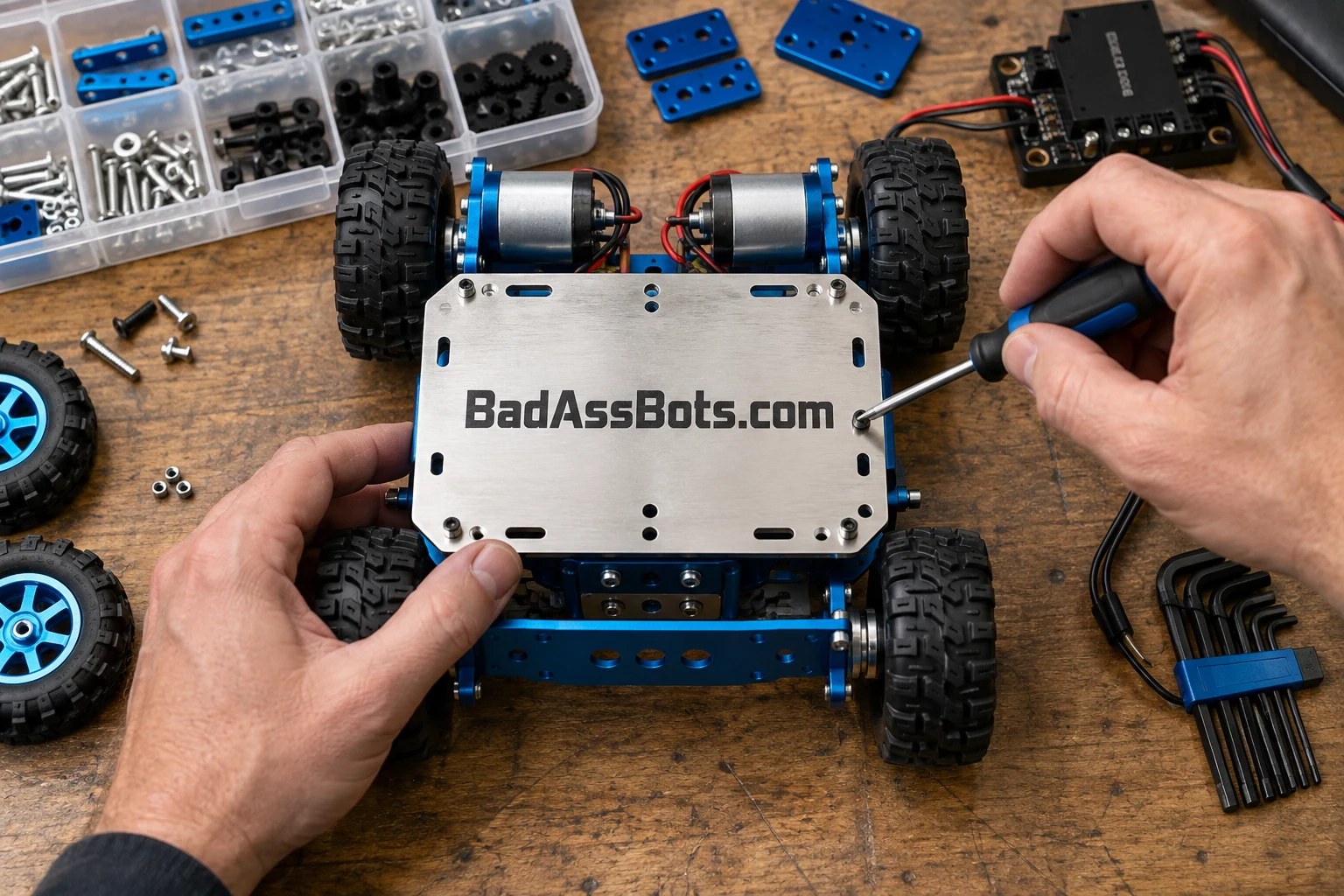
A robotics kit business under BadAssBots.com could serve adults who enjoy building something tangible after a day spent in software or meetings. The first customer does not necessarily want a research platform. They want a well-designed weekend project, a satisfying first movement, and enough room to keep experimenting after the instructions end.
This is an illustrative business concept. The domain's irreverent tone fits an adult workshop brand with capable little machines and straightforward instructions. The promise should rest on the build experience: parts that fit, diagrams that match the hardware, and a clear way to recover when something does not work.
Pick one achievable machine
Start with a compact wheeled robot designed for a defined indoor task. Following a marked route on a flat test board is easier to explain and verify than a general claim about intelligent navigation. Specify the intended surface, space, lighting, and level of supervision. The customer should be able to tell whether their work area is suitable before ordering.
Limit the first kit to one hardware configuration. A choice of several processors, motor sets, and sensor packs looks generous but multiplies the instructions and support cases. One tested configuration lets the business learn where builders struggle. Later versions can add complexity once the basic assembly and software setup are dependable.
Look at the detail in the Pololu Zumo 32U4 user's guide. It documents assembly, components, programming, and hardware differences. That is a useful example of the documentation depth customers need. A new kit must publish its own specifications and tests; another manufacturer's robot does not establish the performance of a proposed product.
Make the first hour a designed experience
Lay out the build in stages with a visible result at each stage. First, check the parts against an illustrated inventory. Next, assemble the chassis without power. Then verify the controller and finally introduce controlled movement. Give the builder a specific checkpoint before they continue, so an error does not remain hidden until the machine is fully assembled.
Use photographs of the actual production revision. Label similar fasteners by length and show orientation where a reversed component would matter. Avoid asking the reader to infer a connector's direction from a distant image. A downloadable parts map should use the same identifiers as the bags in the box and the replacement parts catalog.
The software setup needs equal care. State the supported operating systems and versions tested by the business. Provide a small diagnostic program before the full behavior example. If the controller is detected but a sensor is not, the builder needs a narrow troubleshooting path rather than a suggestion to reinstall everything.
Treat power as part of the product
Choose the power arrangement deliberately and document it with the components used. Do not leave buyers to combine an arbitrary battery, charger, and controller. Where the kit excludes a required item, explain the exact compatible specification and verify the instructions against that configuration. Product design and applicable compliance review require competent engineering before sale.
A basic example of why documentation matters appears in Raspberry Pi's hardware guidance: motors should not connect directly to GPIO pins; a suitable motor controller or H-bridge is needed. The commercial lesson is practical. Every electrical connection in the kit should have a tested purpose and an unambiguous diagram.
Keep the first project away from unnecessary physical hazards. A small robot on a bounded floor area can offer plenty to learn without heavy payloads, exposed high-speed mechanisms, or dramatic obstacle claims. Show how to stop the machine, disconnect power, and inspect it before adjustments. These instructions belong beside the relevant assembly steps.
Build a replacement business alongside the kit
A customer who loses one bracket should be able to buy one bracket. Give wearing and easily misplaced parts durable catalog identifiers. Track compatibility by kit revision and make that information visible on the parts page. If a motor changes, explain which mounting parts and software settings change with it.
Reserve support stock before announcing a batch. Supplier availability can change, so identify components whose substitution would force a redesign or new documentation. A cheap part with one supplier may create more operating risk than a slightly more expensive component with a stable replacement path. Evaluate that tradeoff during prototype purchasing, not after customer orders arrive.
The first offer might be a limited pilot batch with a clearly described support arrangement. Ask builders to record where they pause or improvise. Their questions are valuable product data. Revise the packaging and instructions before treating a recurring problem as something the support team should explain forever.
Show the experience where builders gather
A credible distribution path is a detailed build session at an adult maker group, supported by an unedited assembly chapter online. Show the tools required, a typical correction, and the finished task. A local workshop can reveal physical friction that a polished promotional video hides, such as a connector that is difficult to reach after the top plate is installed.
Keep the initial commercial model understandable: one complete kit, clearly identified required extras, and individual replacement parts. Optional workshops or advanced modules can follow once there is evidence that customers complete and enjoy the core product. Avoid a subscription whose value depends on producing new hardware faster than the business can test it.
The next step is to prototype a single kit and ask an adult builder who did not design it to follow the instructions. Observe quietly, record the trouble spots, and revise the experience. If you want to build this kind of hands-on brand, describe the concept in the inquiry form below to discuss acquiring BadAssBots.com.

About Michael Santiago
Michael founded i-Newswire.com in 2007, growing through iNewswire.com into the category-defining Newswire.com. The business sold to Issuer Direct for $44 million in 2022. That experience informs his belief in clear, memorable names. Today he develops premium domains and companies through OnlineBusiness.com.